
Have you ever wondered why buildings that look solid sometimes fail years earlier than expected? Construction dirt work plays a critical role in whether a foundation remains stable or gradually degrades over time. Studies show that foundation problems account for nearly 70% of reported building collapses, while poor construction practices such as inadequate soil compaction and improper grading contribute to almost 40% of structural failures.
The problem often begins before any concrete is poured. Skipping proper commercial land clearing, ignoring soil conditions, or working without a qualified excavation contractor creates hidden risks beneath the surface. Soil that shifts, traps water, or lacks density can compromise even the strongest foundation.
In this blog post, you will learn how construction dirt work establishes a stable base, manages drainage, and supports long-term structural performance. We will break down each stage of the process and show how careful planning and execution help prevent settlement, cracking, and costly foundation repairs.
Why Construction Dirt Work Determines Foundation Strength
Every foundation transfers weight into the soil below it. If the soil behaves unpredictably, the structure above responds with cracking, shifting, or uneven settlement. Natural ground conditions vary widely due to moisture levels, organic content, and soil composition. Without intervention, these factors increase the risk of structural failure.
Construction dirt work mitigates these risks by creating uniform soil density and controlled drainage conditions. It removes unstable material, stabilizes weak soil, and ensures that the ground performs consistently under load. This preparation allows engineers to rely on their design assumptions and ensures the foundation distributes weight evenly across the site.
In simple terms, dirt work controls how the ground reacts over time, and that reaction determines whether a foundation stays level or slowly fails.
Site Clearing, Soil Testing, and Proper Excavation Depth

The first step in construction dirt work is site clearing. Commercial land clearing removes trees, vegetation, roots, and debris that could decay and leave voids beneath the foundation. Leaving organic material in place almost guarantees future settlement.
Next comes soil testing. Qualified excavation contractors, often working with geotechnical engineers, assess soil composition, moisture content, and load-bearing capacity. These results determine how deep the site must be excavated and whether native soil can remain or requires replacement with engineered fill.
Excavation must be precise. Shallow digging leaves weak soil in place, while excessive excavation adds unnecessary cost. The goal is to create a controlled, stable base that will support grading, compaction, and foundation installation. Proper excavation sets the stage for a long-lasting structure.
Precision Grading and Drainage Control for Stable Foundations
Water causes more foundation problems than any other factor. Clay-rich soils swell when wet, while sandy soils lose cohesion under saturation. Precision grading ensures water flows away from footings and prevents saturation of the load-bearing soil.
Effective grading involves:
- Establishing a minimum slope of about 5 percent for the first several feet from the foundation
- Creating swales or shallow channels to guide runoff to storm drains or natural discharge points
- Integrating subgrade drains or perimeter systems for subsurface water management on larger sites
- Compacting the graded surface to maintain slope integrity
- Verifying drainage paths before foundation placement
Modern construction dirt work uses laser-guided or GPS-controlled equipment to hold tight tolerances. Correct grading protects the foundation from moisture-related damage, supports soil compaction, and ensures that base materials perform effectively.
Need precise grading that protects your foundation from water damage?
Daniel Dean delivers construction dirt work that keeps drainage working long after the build is complete.
Soil Compaction and Base Material Installation
Loose or poorly prepared soil compresses under structural weight, causing settlement, cracked slabs, and wall shifts. Compaction eliminates air voids and increases soil density so the ground can safely carry loads.
In construction dirt work, compaction is done in layers called lifts. Each lift, typically 6–12 inches thick, is mechanically compacted before the next is added. Base materials such as crushed stone or select fill may be added when native soil cannot achieve required density or drainage characteristics. These materials resist expansion, drain efficiently, and distribute loads evenly.
Key steps include the following:
- Layered Compaction (Lifts): Ensures uniform density across the foundation area
- Base Material Installation: Strengthens poor soil and improves drainage
- Compaction Testing: Confirms soil and base reach at least 95% of maximum dry density
- Moisture Conditioning: Adjusts soil moisture to achieve maximum density
Verified compaction ensures the foundation will remain stable over time and prevents costly repairs due to uneven settlement. For projects that also require efficient and thorough site preparation, including clearing the land before construction begins, check out this guide on how to clear land fast for practical tips and expert advice.
Final Inspection to Prevent Settlement and Structural Failure
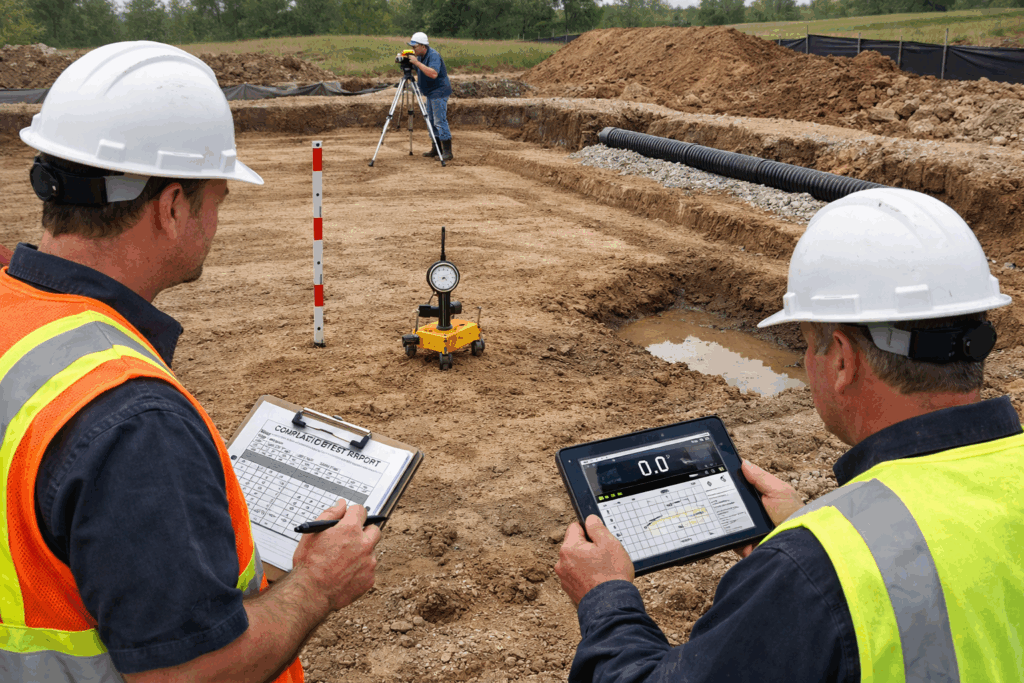
Final inspection verifies that all dirt work meets engineering and design requirements before foundation placement. Inspectors review compaction results, grading accuracy, excavation depth, and drainage paths. This step identifies soft spots, elevation errors, or poorly functioning drainage systems that could compromise the foundation.
Correcting problems at this stage is far more cost-effective than repairing structural failures later. Key inspection checks include:
- Verification of compaction across all lifts
- Confirmation of slope and drainage away from the foundation
- Assessment of excavation depth against engineering plans
- Review of surface and subsurface drainage paths
- Correction of uneven areas or soft spots
For projects that require reliable site preparation and drainage solutions, Daniel Dean provides professional land clearing and excavation services.
Ensure your site is fully prepared before construction begins.
Contact Daniel Dean for expert land clearing and dirt work services today.
Frequently Asked Questions
What is the meaning of dirtwork?
Dirtwork includes all earthmoving activities on a construction site, such as excavation, grading, compaction, and site preparation. Proper dirtwork reshapes and stabilizes soil to create a reliable base for foundations, roads, and other structures, preventing settlement and drainage problems.
What are the 4 types of excavation?
The four main types of excavation are trench excavation for utilities, basement excavation for below-ground structures, site grading or surface excavation for leveling land, and borrow excavation, which removes soil from one area to use as fill elsewhere. Each type serves a specific purpose depending on the project.
What is dirt used for in construction?
Dirt is used to create stable foundations, level construction sites, provide backfill around structures, and manage drainage. Properly prepared soil supports building loads and minimizes settlement or shifting. Weak native soil is often replaced or supplemented with engineered fill or crushed stone to ensure long-term stability.
Final Thoughts on Executing Construction Dirt Work Correctly
Construction dirt work is the foundation of any successful build. From commercial land clearing and soil testing to precision grading, compaction, and final inspection, each step ensures that your foundation remains stable and performs as designed. Proper execution prevents settlement, cracking, and costly repairs, while poor preparation can compromise even the strongest structures.
To protect your project, start by hiring a qualified excavation contractor and ensure that every stage of dirt work is carefully planned and executed. Verify grading, compaction, and drainage, and address any issues before concrete placement.
If you are planning a project or have questions about site preparation, grading, or land clearing, Daniel Dean can provide expert guidance and professional services to ensure your site is fully ready for construction.
Contact us today here to discuss your project or request a consultation for land clearing, excavation, and construction dirt work services.