
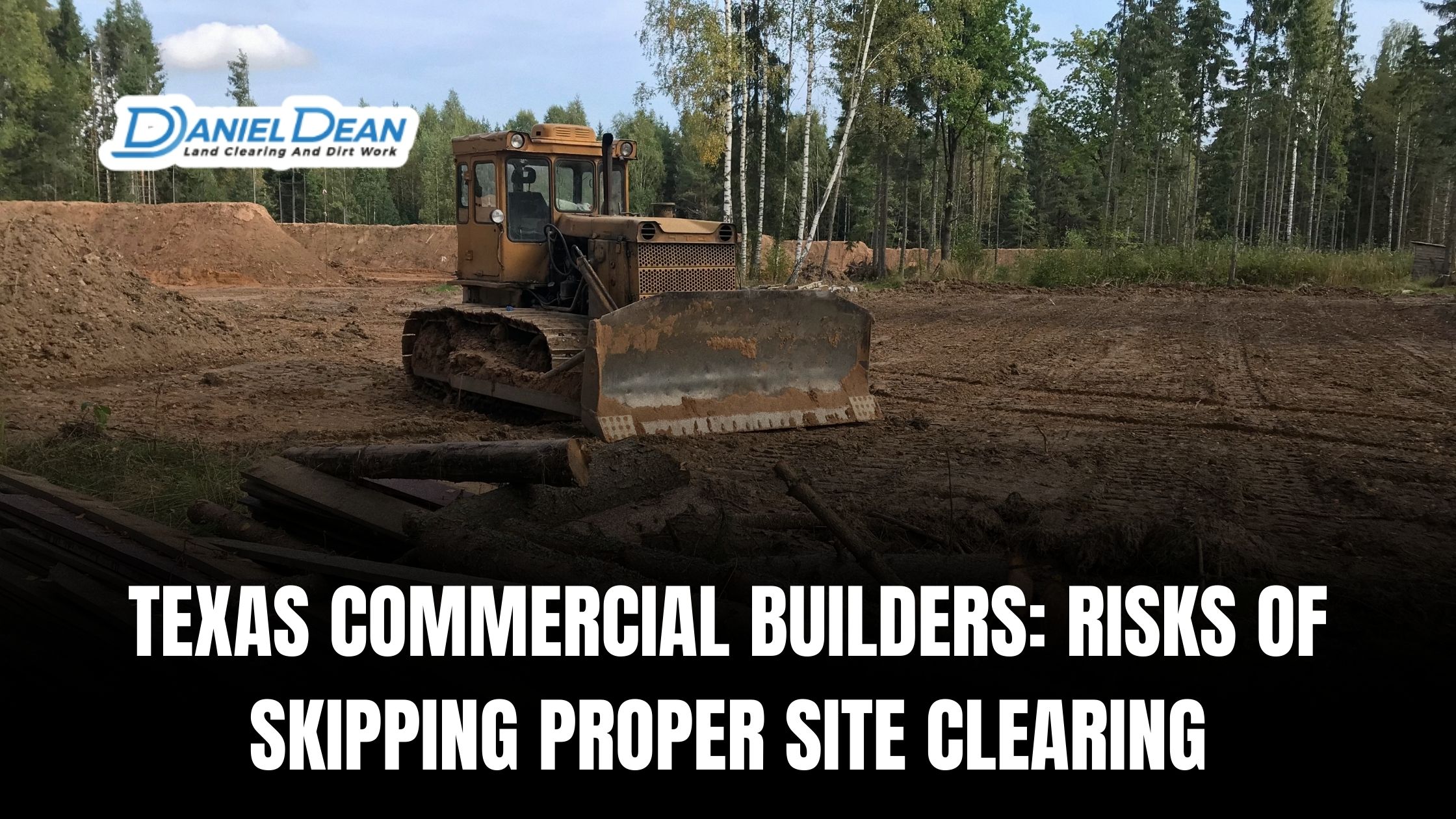
Have you ever wondered why so many commercial projects struggle before construction even begins? Texas commercial builders operate in some of the fastest growing markets in the country, yet many still underestimate the impact of early site preparation. Texas commercial builders face higher risk in commercial construction Texas because rushed decisions at the land stage often lead to avoidable delays and compliance problems.
Across major hubs like construction Houston TX, studies show that large scale projects can run about 20% longer than planned when teams skip proper site assessments. At the same time, regulators enforce strict standards. The Texas Commission on Environmental Quality can issue penalties that exceed twenty-five thousand dollars per day when land clearing or stormwater controls fail to meet requirements. These realities turn site preparation into a high stakes phase rather than a simple starting point.
In this blog post, we explain how skipping professional commercial land clearing creates physical, financial, and legal risks. You will learn how informed planning helps Texas commercial builders protect timelines, budgets, and long-term project value.
Site Clearing as the Foundation of Commercial Construction in Texas
For commercial construction Texas projects, a site must be more than just “empty” before the foundation is poured. It must be engineered. Professional site clearing involves the removal of surface vegetation and the vital process of “grubbing,” which extracts root systems and buried debris. In the rich soils of the Texas Blackland Prairie or the soft coastal plains, failing to remove these organic materials leads to long term instability as they decay and create subsurface voids.
A properly cleared site serves as the precise “pad” required for heavy machinery and material staging. This phase also includes initial grading and the removal of “unsuitable” soils that cannot meet compaction standards. By establishing a clean, predictable slate, builders ensure that the subsequent layers of select fill and concrete slab rest on a base that has been verified for structural integrity rather than one hiding pockets of decomposition.
This stage also sets the pace for the entire build. When a site is cleared thoroughly, subcontractors can move equipment with precision, surveyors can provide more accurate readings, and the geotechnical team can perform soil testing on a stable surface. Transitioning from raw land to a construction-ready site requires this level of detail to avoid the physical failures that often follow a “slash and burn” approach.
Physical Risks: Soil Disturbance, Drainage Failures, and Load Issues
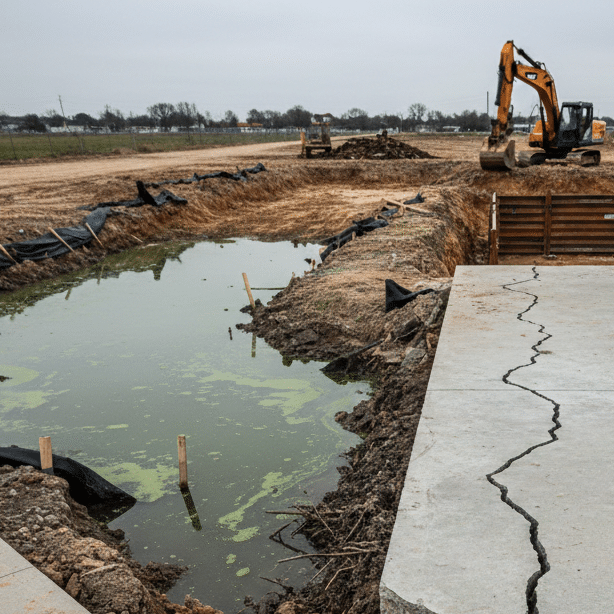
Texas is notorious for its expansive clay soils, which undergo intense shrink-swell cycles during the state’s frequent droughts and floods. When Texas commercial builders ignore comprehensive land clearing, they risk leaving behind roots and organic matter that exacerbate soil movement. If these materials are trapped under a slab, they rot and leave gaps that cause the foundation to shift, leading to masonry cracks and structural misalignment.
Drainage is another area where shortcuts lead to disaster. In construction Houston TX, the flat terrain and high water table require a grading accuracy of at least 1% to 2% to move water away from the structure. Improperly cleared land often masks natural gullies and low spots. If these are not corrected during the clearing phase:
- Water pools against the foundation, creating hydrostatic pressure.
- Soil erosion undermines parking lots and perimeter walkways.
- Basement or crawlspace areas suffer from chronic moisture intrusion and mold.
Load-bearing capacity is also compromised when debris is buried rather than hauled away. OSHA classifies soil stability into types A, B, and C based on cohesive strength. Improperly cleared or “previously disturbed” soil rarely qualifies for Type A status, requiring more expensive shoring and reinforcement during excavation. Without a uniform, cleared base, the building’s weight is distributed unevenly, which can lead to “differential settlement,” a condition where one part of a building sinks faster than another.
Financial Risks: Delays, Rework, and Escalating Site Preparation Costs
The cost of fixing a site prep error after the building is vertical is often ten times the cost of doing it correctly at the start. For a typical project in construction Houston TX, discovering a buried stump or a forgotten utility line during foundation excavation can stop production for weeks. During this time, heavy equipment sits idle while costing the developer thousands of dollars per day in rental fees and lost labor.
Rework is perhaps the greatest threat to a project’s profit margins. If a slab fails due to poor compaction or organic decay beneath the surface, the remediation costs can be staggering. These expenses often include:
- Mechanical underpinning or piering to stabilize a sinking foundation.
- Extensive repairs to interior finishes, plumbing lines, and electrical systems.
- Environmental remediation if hidden underground storage tanks or hazardous debris are uncovered late in the process.
Furthermore, skipping the investment in high-quality commercial land clearing often leads to change order cascades. When the initial site clearing is incomplete, every subsequent contractor must adjust pricing to account for unforeseen conditions. This lack of transparency makes fixed-price contracts difficult to maintain and increases the risk of budget overruns. Avoiding common site preparation mistakes helps protect project budgets and long-term viability.
Legal and Operational Risks: Permits, Safety Exposure, and Project Shutdowns
In the modern regulatory environment, Texas commercial builders are under intense scrutiny from both state and federal agencies. The Texas Commission on Environmental Quality (TCEQ) requires any project disturbing one acre or more to obtain a Stormwater Pollution Prevention Plan (SWP3). Improper clearing that fails to include silt fences or stabilized construction entrances can result in fines exceeding $25,000 per day per violation.
Safety is the other major operational risk. A site that has not been properly cleared and leveled is a high-risk environment for workers. Unclear paths and hidden holes lead to:
- Equipment tip-overs involving excavators or forklifts.
- Severe “slip, trip, and fall” injuries that trigger OSHA investigations.
- Accidental utility strikes because the area was not cleared enough to see markers or perform “811 One-Call” verification.
Beyond safety concerns, permit revocation presents a serious operational risk for Texas commercial builders. Local inspectors in major metro areas often require a clearing and grubbing inspection before they approve the next permit phase.
When inspectors find violations tied to environmental codes or public drainage impacts, they can issue a stop work order that halts progress immediately. These interruptions extend beyond schedule delays. They weaken a builder’s compliance record and make bonding and insurance approvals more difficult on future projects. This makes proper commercial land clearing a critical step for maintaining compliance and project continuity.
Trusted Commercial Land Clearing Partner for Texas Construction Projects
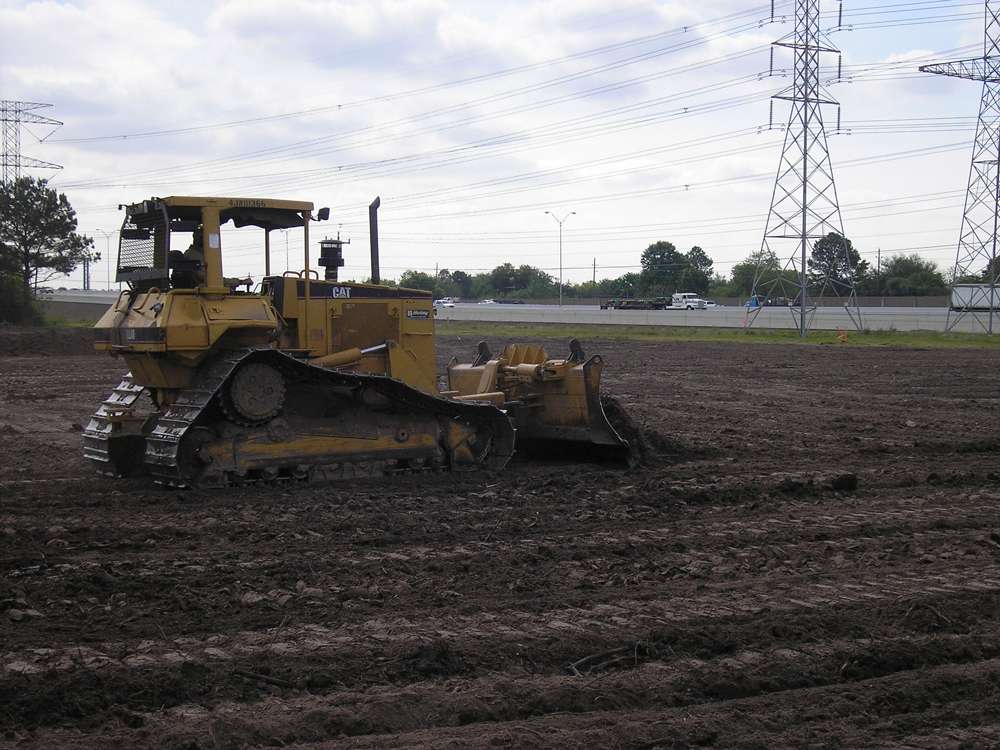
For Texas commercial builders, starting a commercial construction Texas project without professional site preparation can create serious setbacks. Daniel Dean provides full-service commercial land clearing designed specifically for Houston, Dallas, and Austin projects. The team handles everything from clearing dense brush, removing large stumps, and hauling construction debris to precise grading that addresses expansive clay soils and water runoff patterns. Proper preparation ensures foundations, parking lots, and utility lines are built on stable ground, preventing costly structural failures and schedule delays.
Daniel Dean works closely with Texas commercial builders to meet local regulations, including TCEQ stormwater management requirements and city permitting standards. In construction Houston TX and across Texas, these measures prevent permit delays and stop work orders while giving crews a build-ready site.
Professional commercial land clearing also reduces hidden risks like buried debris, uneven soil, and erosion hazards, which protects project budgets and maintains long-term property value.
| Service | Specific Benefit |
| Dense brush and tree removal | Eliminates roots and vegetation that can compromise foundation stability |
| Stump extraction and debris hauling | Prevents subsurface voids and hidden hazards for heavy equipment |
| Precise grading and soil compaction | Controls drainage, reduces erosion, and prepares uniform load-bearing surfaces |
| Regulatory compliance support | Ensures TCEQ stormwater and city permit standards are met before construction |
Protect your timeline and budget with expert site preparation. Schedule a consultation with Daniel Dean for commercial land clearing that keeps your Texas projects on track.
Frequently Asked Questions
Which builder has the best quality in Texas?
The best quality builders in Texas focus on strong planning, experienced crews, and reliable site preparation. High quality outcomes usually come from teams that invest in proper land clearing, soil evaluation, and compliance before construction begins. Texas commercial builders who prioritize these fundamentals tend to deliver safer structures, fewer delays, and better long term performance.
What is the biggest construction company in Texas?
Texas is home to many large construction firms that handle commercial construction Texas projects across multiple cities. Size alone does not determine success. For many projects, especially in construction Houston TX, experience with local conditions, regulations, and site preparation matters more than company scale.
Who builds the best manufactured homes in Texas?
The best manufactured home builders in Texas follow strict quality controls, use compliant building materials, and prepare sites correctly before installation. Proper commercial land clearing and site preparation play a major role in durability, drainage control, and overall home performance, regardless of the builder’s size.
Final Thoughts on Texas Commercial Builders
Texas commercial builders face real physical, financial, and regulatory risks when site clearing does not receive the attention it deserves. Poor land preparation leads to soil instability, drainage failures, costly rework, permit delays, and long-term structural problems that affect the entire lifecycle of a project. In fast-moving markets across commercial construction Texas, especially in construction Houston TX, proper site clearing protects schedules, budgets, and compliance standing. Professional commercial land clearing creates stable ground, supports inspections, and allows construction teams to move forward with confidence.
The next step is simple. Treat site preparation as a strategic investment, not a shortcut. Builders and developers who want fewer delays and stronger project outcomes should work with experienced professionals who understand Texas soil, drainage, and regulations. For questions about commercial land clearing or other site preparation services, reach out through the Daniel Dean contact page to discuss your project needs and get expert guidance before construction begins.