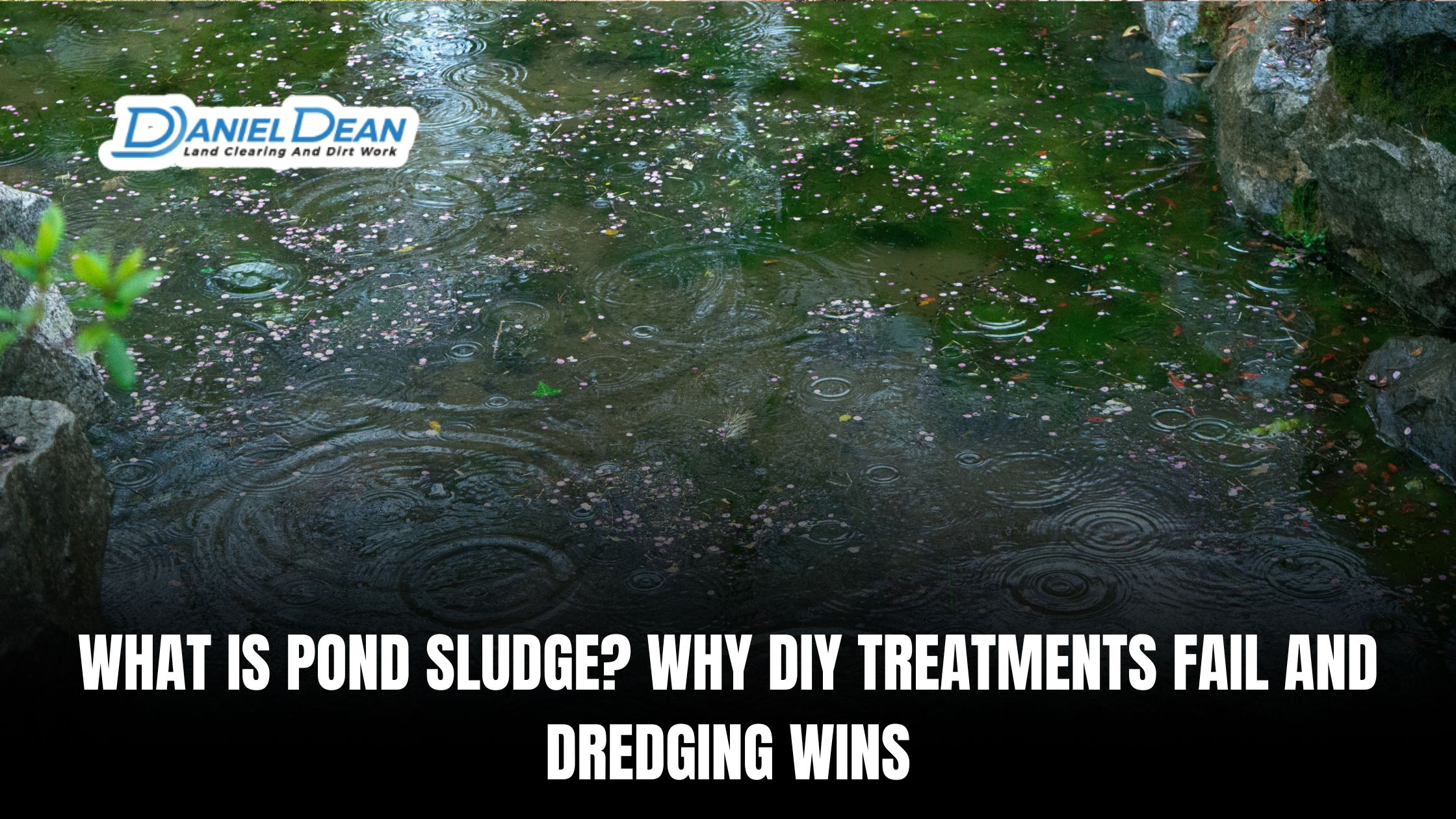
If your pond smells like rotten eggs every summer and turns pea-green no matter what you throw at it, you are probably dealing with something that liquid bacteria and aeration systems simply cannot fix. Pond sludge is not just dirty water. It is a dense, compacted layer of decomposed organic matter sitting at the bottom of your pond, and once it builds up past a certain point, no bottle of treatment is going to touch it. We have seen this play out on hundreds of Texas properties, and the story is almost always the same.
The bottom line: thick sludge requires physical removal, not chemical band-aids.
Here is what the research says before we go further:
- Small ponds accumulate sediment at an average rate of 2.96 cm per year, which compounds into significant volume loss over a single decade. (ScienceDirect, 2024)
- A modeled stormwater pond lost 24% of its total volume over just 32 years due to sediment deposition averaging 2 cm per year. (ScienceDirect, 2019)
What Is Pond Sludge, Exactly?
Pond sludge is the thick, dark layer of semi-decomposed material that settles and compacts on the floor of a pond over time. It is made up of dead leaves, grass clippings, fish waste, algae, decayed aquatic plants, and eroded soil that washes in from the surrounding land.
Here is the part most people do not fully understand. That muck is not just sitting there passively. It is biologically active in the worst possible way. Once the sludge layer gets thick enough, it becomes what scientists call an anaerobic zone, meaning oxygen cannot reach it. In that oxygen-deprived layer, anaerobic bacteria take over and begin producing hydrogen sulfide gas. That is where the rotten egg odor comes from when you disturb the bottom of a sludge pond.
What makes this layer so stubborn is its physical structure. The deeper sediment compacts under its own weight over time, forming a semi-solid mass that is completely cut off from the water column above it. Aerobic decomposition, the kind that would actually break down organic matter cleanly, requires oxygen to reach the material. In a compacted sludge bed, that oxygen never arrives.
The result is a cycle that gets worse every season:
- Sludge releases nutrients like phosphorus and nitrogen into the water column
- Those nutrients feed algae blooms and excessive aquatic weed growth
- Dead algae sinks and adds more organic matter to the sludge layer
- The sludge layer grows thicker and the problem accelerates
This is why property owners across Southeast Texas keep coming to us at Daniel Dean after years of fighting the same pond problems with treatments that do not work.
Why DIY Treatments and Liquid Products Fail on Thick Sludge
We are not here to tell you that pond bacteria products are useless. In a well-maintained pond with a thin layer of surface organics, biological treatments can help keep things in balance. That is a different situation entirely from a sludge pond with 12 or 18 inches of compacted muck on the bottom.
Here is the core problem with liquid bacteria and enzyme treatments when sludge gets thick.
- They cannot reach the problem. Beneficial bacteria need oxygen to do their work. In a dense, compacted anaerobic sludge layer, there is no oxygen. You are essentially pouring aerobic bacteria into an environment where they cannot survive long enough to have any meaningful effect on the material that matters.
- Aeration has the same limitation. Surface aerators and diffuser systems help circulate oxygen in the upper water column and can slow down future sludge accumulation. But they do not excavate. They do not break up compacted sediment that has been building for 10 or 15 years. We have visited properties where owners spent thousands on aeration equipment over multiple years and still had three feet of sludge on the bottom.
- Algaecides treat the symptom, not the source. Killing the surface algae bloom feels like progress, but the nutrient-rich sludge that is feeding the bloom is still there. The algae comes back. Every time. Until the underlying layer is removed, you are just managing a recurring problem indefinitely.
The honest truth is that recurring treatments have a real cost. When you add up what property owners spend on annual bacteria treatments, algaecides, aeration equipment maintenance, and water testing over five to ten years, that number often rivals or exceeds what a one-time mechanical dredging would have cost. The difference is that dredging actually solves the problem.
For property owners dealing with broader land issues around the pond area, this same principle applies. In our tree and brush removal work, we see the same pattern where surface-level fixes delay the inevitable. The right equipment and approach from the start saves significant money over time.
What Is Pond Sludge Doing to Your Property Value and Pond Health?
Beyond the smell and the algae, a sludge pond creates a cascade of practical problems that get worse the longer you wait.
- Depth loss is real and it accumulates. A pond that was dug to eight feet may now be five feet deep in the center and three feet deep near the banks. That reduced depth warms the water faster in summer, which stresses fish and accelerates algae growth. It also reduces your pond’s capacity to hold water during heavy rains, which can create drainage issues on surrounding land. This is something we discuss in detail when property owners ask about commercial versus residential dirt services, because drainage capacity and pond depth are closely tied to how a property functions overall.
- Fish populations suffer. When the bottom layer goes anaerobic, dissolved oxygen levels in the water column drop. Fish that depend on stable oxygen levels begin to stress, and during hot Texas summers, a severe oxygen depletion event can cause a fish kill. We have seen beautiful bass ponds turned into stagnant, foul-smelling water features because the sludge problem went unaddressed for too long.
- Shoreline erosion accelerates. As a pond fills with sediment and loses depth, water has less room to go, which pressures banks and causes erosion. Understanding Texas land clearing and site preparation costs becomes relevant quickly when erosion damage around a neglected pond needs to be corrected alongside the dredging itself.
How to Dredge a Pond: What the Process Actually Looks Like

Knowing how to dredge a pond starts with understanding that it is mechanical excavation work, not a chemical treatment. You are physically removing the accumulated material from the bottom and hauling it away or repurposing it on-site.
At Daniel Dean, here is how we approach a typical dredging project in Southeast Texas:
- Site Assessment First. We assess the pond’s current depth versus its original design depth, measure sediment accumulation, evaluate access points for equipment, and look at the surrounding drainage patterns. This tells us what we are dealing with before we commit to a method or timeline.
- Equipment Selection. The right equipment depends on the pond size, sediment consistency, and access. Texas clay soils behave differently than sandy sediment found in other parts of the country, and our equipment is suited to those conditions. For most residential and estate ponds in the Houston area, we can work without fully draining the pond, which protects fish populations and speeds up the project timeline.
- Sediment Removal and Disposal. Dredged material is not just waste. Nutrient-rich pond muck can often be used as fill or spread on adjacent land as a soil amendment. We discuss disposal and repurposing options during the consultation so nothing goes to waste when it does not have to.
- Inspection and Restoration. After the dredging is complete, we verify that the original depth and inflow and outflow structures are functioning correctly. If erosion control or bank stabilization is needed, we address that as part of the same project.
Most residential pond dredging jobs in our area take one to three days depending on pond size and sediment volume. Larger commercial or agricultural ponds take longer, and we plan accordingly.
When a Pond Is Past the Point of Treatment Products
This is a question we get asked directly, and we would rather give a straight answer than a vague one.
If any of the following apply to your pond, you are past the point where liquid bacteria, enzymes, or aeration alone will solve the problem:
- Sludge depth is greater than 6 to 8 inches across most of the pond floor
- You have been treating with bacteria or algaecides for multiple seasons with no lasting improvement
- The pond has visibly lost depth compared to when it was built or last maintained
- There is a persistent sulfur odor even when the water surface looks clear
- Fish kills have occurred during summer months
- Algae returns within weeks of each treatment
At that point, the anaerobic layer is too thick and too compacted for biological treatments to penetrate. Physical excavation is the only approach that addresses the actual problem.
The Cost Comparison That Most People Do Not Run
| Approach | Typical Annual Cost | Addresses Root Cause? |
| Liquid bacteria treatments | $300 to $800/year | No |
| Algaecides | $400 to $1,200/year | No |
| Surface aeration systems | $1,500 to $4,000 installed | Partially |
| Professional dredging | $2,500 to $12,000 one-time | Yes |
A property owner spending $1,500 per year on combined treatments over ten years has spent $15,000 and still has a sludge problem. A one-time dredging at $5,000 solves it in one to three days.
Our pond dredging services are built around giving you a permanent fix, not a recurring product cycle.
What to Do Next If You Suspect Sludge Is Your Problem
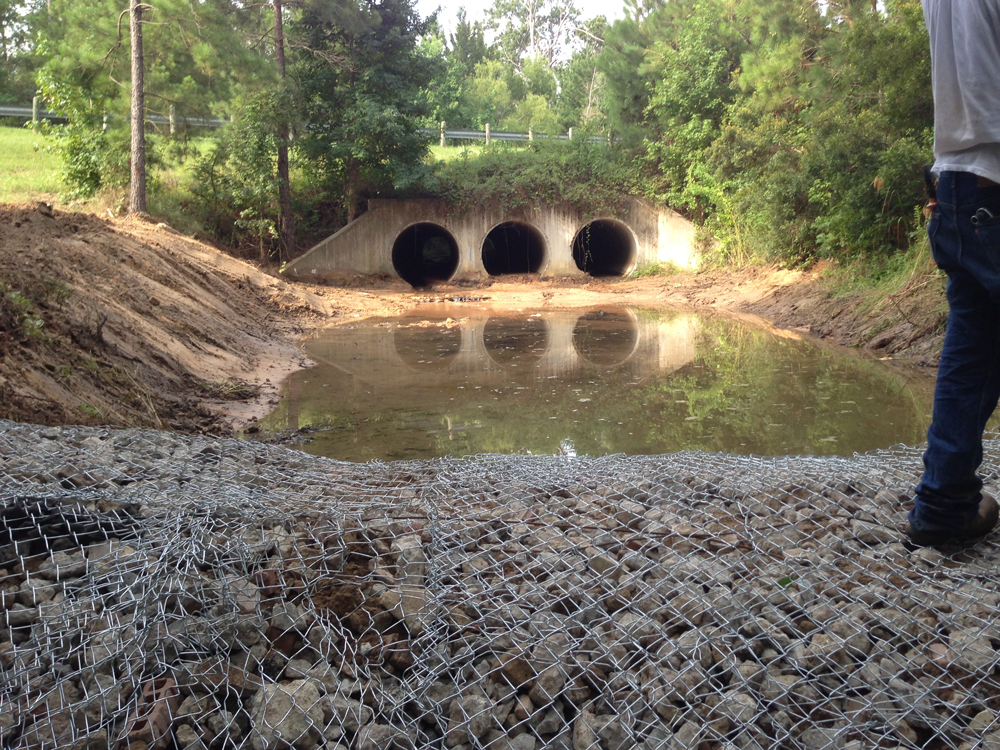
The first step is a site evaluation. We serve a 100-mile radius from Magnolia, Texas, covering Houston, The Woodlands, Conroe, Katy, Sugar Land, Montgomery County, and surrounding Southeast Texas communities.
Visit danieldean.com to request a free quote or call us directly. We will come out, assess your pond, give you an honest read on whether dredging is actually what you need, and provide a clear cost estimate before any work begins. Straight answers from a team that has been doing this since 1993.
Frequently Asked Questions
How do I get rid of sludge in my pond?
The best way to remove pond sludge depends on how much has accumulated. Small amounts may respond to bacteria treatments and aeration, but thick, compacted sludge usually requires professional dredging to physically remove the material and restore the pond’s original depth.
Is pond sludge harmful to humans?
Pond sludge can contain bacteria, algae, and decomposing organic matter that may cause unpleasant odors and skin irritation after direct contact. While occasional exposure is not usually dangerous, avoiding contact with heavily contaminated sludge and washing thoroughly afterward is recommended.
Is pond sludge good for plants?
In some cases, dredged pond sludge can benefit plants because it contains organic matter and nutrients. However, the material should be evaluated before use since excessive nutrients, contaminants, or poor drainage characteristics can make it unsuitable for certain landscaping or gardening applications.
Final Thoughts on What Is Pond Sludge
Pond sludge is a natural process, but letting it accumulate past the point of no return is not. If the bottom of your pond has turned into a thick anaerobic layer of compacted muck, no product on the market is going to reach it and fix it. What is pond sludge at its worst? It is a pond killer that works slowly and quietly until the problem is impossible to ignore.
Dredging is not the most glamorous solution, but it is the right one. We have done it on hundreds of Texas properties, and the results speak for themselves. Clear water, restored depth, healthy fish, and no more yearly treatments that accomplish nothing.